

Understanding Reading Comprehension Research and Instruction: The Foundation
Reading comprehension is often described as the “essence of reading” and the ultimate goal of reading instruction. But what exactly is it? According to research, reading comprehension is not simply extracting meaning from text—it’s an active process where readers construct meaning by integrating new information with their existing knowledge.
The Simple View of Reading, developed by Gough and Tunmer, provides a framework for understanding reading comprehension as the product of two essential components: decoding (word recognition) and language comprehension. This model helps explain why some students might struggle with comprehension despite being able to decode words effectively—they may have challenges with the language comprehension component.
Dr. Hollis Scarborough’s Reading Rope model further illustrates this concept by showing how multiple strands of literacy skills are woven together to create skilled reading. The model demonstrates that word recognition and language comprehension develop simultaneously, not sequentially, highlighting the importance of addressing both areas in reading instruction.
“Reading comprehension is the process of simultaneously extracting and constructing meaning through interaction and involvement with written language.”
Effective teacher skills in reading comprehension instruction require understanding these foundational concepts and recognizing that comprehension is a complex cognitive process that can be explicitly taught and developed through strategic instruction.
Explore our comprehensive guide to teaching reading comprehension strategies →
The Synergy Between Word Recognition and Reading Comprehension Research and Instruction
One common misconception in literacy education is the idea that students must “learn to read” before they can “read to learn.” Research indicates that this sequential approach is not optimal. Instead, word recognition and language comprehension instruction should occur simultaneously, with each reinforcing the other.
Word Recognition
Word recognition skills include:
- Phonemic awareness
- Phonics
- Decoding
- Sight word recognition
- Orthographic mapping
These skills allow students to accurately identify written words and are essential for fluent reading.
Language Comprehension
Language comprehension components include:
- Vocabulary knowledge
- Background knowledge
- Language structures
- Verbal reasoning
- Literacy knowledge
These skills enable students to understand the meaning of words and connected text.
Developing teacher skills in both areas is crucial. When students struggle with word recognition, their cognitive resources are consumed by decoding, leaving little mental energy for comprehension. Conversely, strong language comprehension skills provide context that can support word recognition.
Orthographic mapping represents an important bridge between these two domains. This process allows readers to form connections between the letters in words (orthography), their sounds (phonology), and their meanings (semantics). As students develop orthographic mapping skills, they build their sight vocabulary, which frees up cognitive resources for comprehension.
Research by Cromley and Azevedo (2007) confirms that these components work together synergistically rather than competitively. Teacher skills that address both word recognition and language comprehension simultaneously create the most effective reading instruction.
The Role of Knowledge Building in Reading Comprehension Research and Instruction
When controlling for other factors, research shows that background knowledge plays the largest role in comprehension. The more a student knows about a topic, the more likely they are to successfully comprehend a text about it. This finding has significant implications for classroom practice.
As Zaretta Hammond notes, “For instruction to be truly liberatory and for learning to be sticky, it has to help students expand what they know, make deep connections across disciplines, and integrate new content into their existing funds of knowledge.” Building teacher skills in knowledge development is therefore essential for effective comprehension instruction.
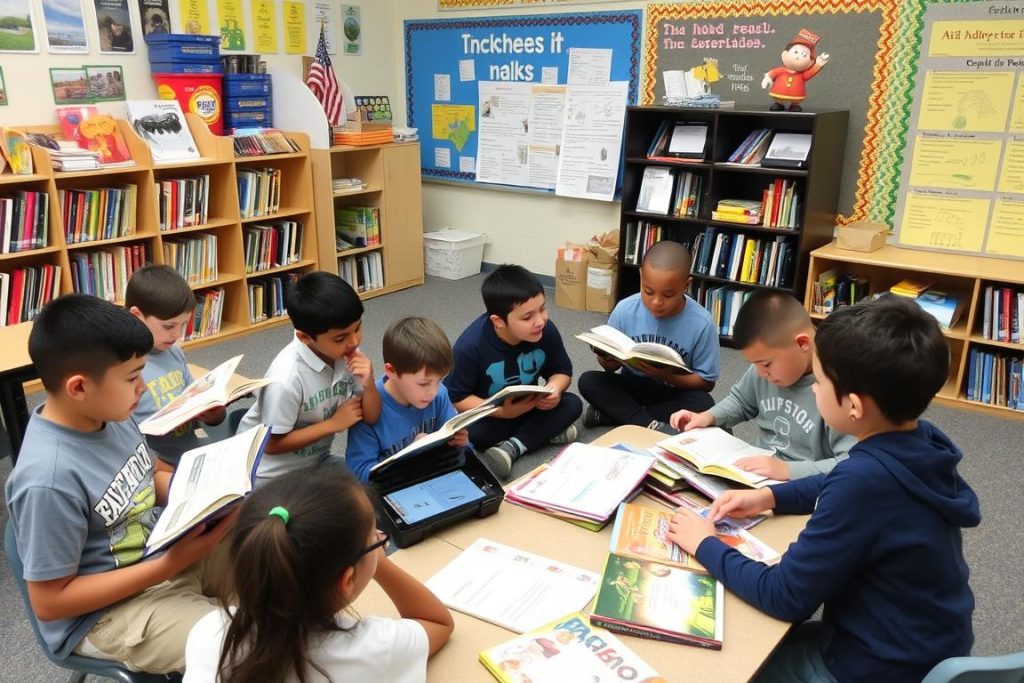
Effective Knowledge-Building Practices
Research identifies several evidence-based approaches to building knowledge that supports reading comprehension:
Wide Reading
Reading volume has long been associated with general world knowledge. The more children read across diverse topics, the more they learn about the world. Teacher skills should include methods to encourage wide reading that leverages students’ curiosity and intrinsic motivation.
Read-Alouds
Teacher read-alouds introduce students to new topics and vocabulary while building listening comprehension. They also provide access to grade-level text and sophisticated content that students might not be able to decode independently.
Access to Complex Text
Exposure to engaging and conceptually rich texts, especially nonfiction, is essential for students to build knowledge of the world. Students who are exposed to informational texts through read-alouds are more likely to choose those kinds of texts for independent reading.
Connected text sets—collections of texts organized around a common topic or theme—are valuable tools for knowledge building, but they’re not the only approach. Teacher skills should include the ability to implement multiple knowledge-building practices to support diverse learners.
Discover resources to support knowledge building in your classroom →
Evidence-Based Reading Comprehension Research and Instruction Strategies
Explicit instruction in comprehension strategies is a critical component of effective reading instruction. These strategies help students actively engage with text, monitor their understanding, and apply fix-up strategies when comprehension breaks down.
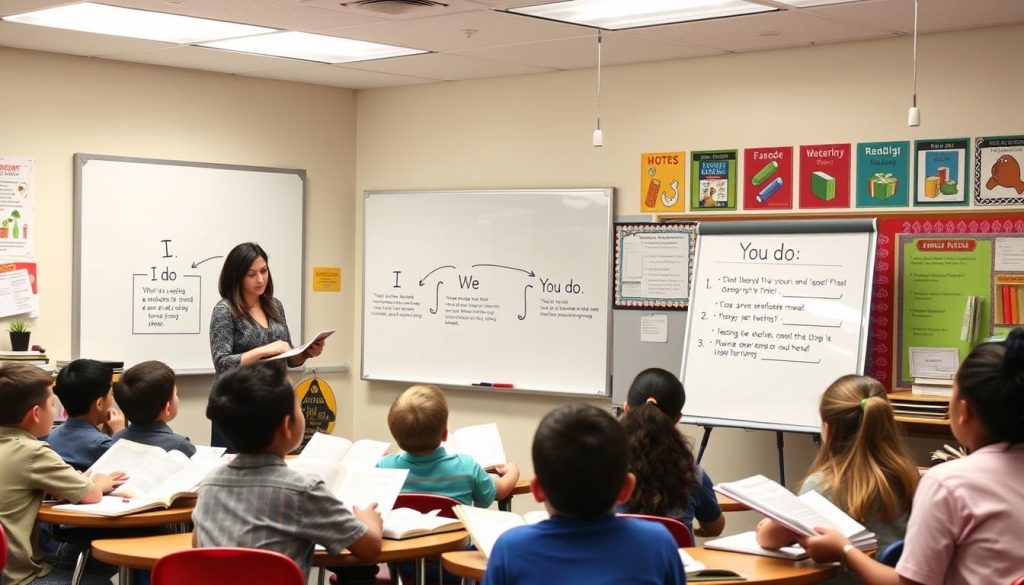
Developing teacher skills in strategy instruction requires understanding both what to teach and how to teach it. The gradual release of responsibility model (“I do, We do, You do”) provides an effective framework for strategy instruction:
- Direct explanation (“I do”): The teacher explains why the strategy helps comprehension and when to use it, modeling through think-alouds.
- Guided practice (“We do”): The teacher works with students, guiding them in applying the strategy.
- Independent practice (“You do”): Students apply the strategy independently with teacher feedback as needed.
Key Comprehension Strategies
Research supports the explicit instruction of several comprehension strategies that readers can employ before, during, and after reading:
| Strategy | When to Use | Description | Grade Level |
| Activating Prior Knowledge | Before & During | Students connect what they already know to what they’re reading, creating a framework for new information. | 1st grade and up |
| Predicting | Before & During | Students make thoughtful guesses about what might happen next based on text clues and background knowledge. | 1st grade and up |
| Questioning | During | Students generate questions about the text using who, what, where, when, why, and how. | 1st grade and up |
| Visualizing | During | Students create mental images of what they’re reading, which improves recall and comprehension. | 1st grade and up |
| Inferring | During | Students use clues from the text combined with background knowledge to draw conclusions about what the author implies but doesn’t state directly. | 3rd grade and up |
| Monitoring Comprehension | During | Students check their understanding and apply fix-up strategies when meaning breaks down. | 2nd grade and up |
| Determining Importance | During & After | Students identify key ideas, themes, and supporting details in the text. | 3rd grade and up |
| Synthesizing | After | Students combine important ideas and their own thinking to develop new understandings. | 3rd grade and up |
Effective teacher skills include knowing when and how to teach these strategies based on student needs and text demands. It’s important to remember that strategies are tools to support comprehension, not ends in themselves. The goal is for students to apply these strategies flexibly and independently as needed.
Ready to enhance your reading comprehension instruction?
Access our comprehensive guide to teaching reading comprehension strategies, complete with lesson plans, graphic organizers, and assessment tools.
Understanding Text Structure in Reading Comprehension Research and Instruction
Research shows that understanding text structure—the way information is organized within a text—significantly impacts comprehension. When students recognize common organizational patterns, they can better anticipate how information will be presented and more easily identify key points.
Developing teacher skills in text structure instruction helps students navigate both fiction and nonfiction texts more effectively. Explicit teaching of text structures gives students a framework for organizing information, making it easier to comprehend and retain what they read.
Fiction Text Structures
- Characters
- Setting
- Problem/Conflict
- Plot/Action
- Resolution
- Theme
Nonfiction Text Structures
- Description/Definition
- Sequence/Process
- Compare-Contrast
- Cause-Effect
- Problem-Solution
- Question-Answer
Effective teacher skills include explicitly teaching signal words and phrases that indicate specific text structures. For example, words like “first,” “next,” and “finally” signal a sequence structure, while “similarly,” “in contrast,” and “however” indicate a compare-contrast structure.
Graphic organizers tailored to specific text structures can help students visualize and organize information as they read. These tools support comprehension by making the structure explicit and providing a framework for note-taking and summarization.
Teaching Text Structure: A Gradual Approach
Research suggests a developmental sequence for teaching text structures:
- Begin with simpler structures like sequence and description in early grades.
- Introduce compare-contrast and cause-effect in intermediate grades.
- Move to more complex structures like problem-solution and claim-evidence in upper elementary and middle grades.
Teacher skills should include the ability to select texts that clearly exemplify specific structures and to scaffold instruction appropriately based on student readiness.
Question Types in Reading Comprehension Research and Instruction
Questions are powerful tools for developing and assessing comprehension. Research indicates that different question types engage different cognitive processes and levels of thinking. Developing teacher skills in crafting and using various question types is essential for comprehensive reading instruction.
Taxonomy of Comprehension Questions
Effective comprehension instruction incorporates questions that address different levels of understanding:
Literal Questions
These questions have answers directly stated in the text. They focus on recall of specific details, facts, or events. While basic, they establish a foundation for deeper comprehension.
Example: “What color was the main character’s house?”
Inferential Questions
These questions require students to “read between the lines” by combining text information with background knowledge to draw conclusions not explicitly stated.
Example: “Why do you think the character made that decision?”
Evaluative Questions
These questions ask students to make judgments, form opinions, or analyze the author’s craft based on the text and their own knowledge or values.
Example: “Do you agree with how the author resolved the conflict? Why or why not?”
Additional question types that support comprehension include:
- Vocabulary questions: Focus on word meanings within context
- Main idea questions: Require identifying central themes or concepts
- Cause and effect questions: Explore relationships between events
- Compare and contrast questions: Examine similarities and differences
- Author’s purpose questions: Consider why the author wrote the text
Effective teacher skills include strategically incorporating these question types before, during, and after reading to guide students toward deeper understanding. Research shows that higher-order questions that require analysis, synthesis, and evaluation are particularly effective for developing critical thinking.
Differentiating Reading Comprehension Research and Instruction for Diverse Learners
Research consistently shows that effective reading comprehension instruction must be responsive to students’ diverse needs. Developing teacher skills in differentiation ensures that all students can access and benefit from comprehension instruction.
“Comprehension is never all or nothing—it exists on a continuum. Effective instruction recognizes and addresses this multidimensional nature.”
Considerations for Different Age Groups
Research indicates that comprehension strategy instruction should be tailored to students’ developmental readiness:
Early Readers (K-2)
For younger students, teacher skills should focus on:
- Building word recognition and fluency
- Developing oral language and listening comprehension
- Modeling comprehension strategies through read-alouds
- Using visual supports and concrete examples
Developing Readers (3-5)
As students progress, teacher skills should include:
- Explicit strategy instruction with gradual release
- Building knowledge across content areas
- Teaching text structures and features
- Balancing narrative and informational texts
Advanced Readers (6-12)
For older students, teacher skills should emphasize:
- Applying strategies to increasingly complex texts
- Developing critical literacy and analytical skills
- Integrating reading and writing
- Supporting discipline-specific literacy
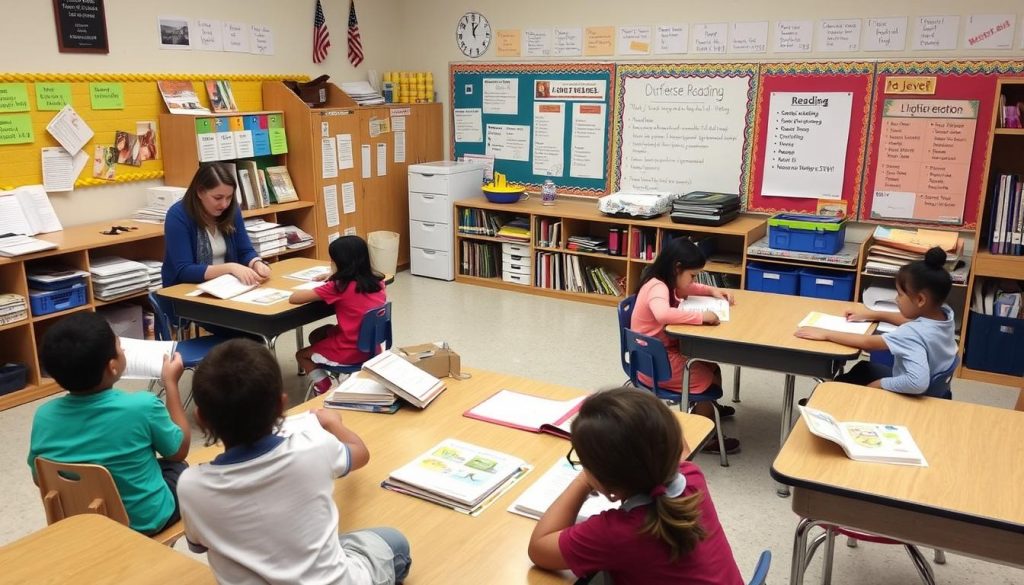
Supporting Struggling Readers
Research by Duke, Ward, and Pearson (2021) emphasizes that struggling readers benefit from the same evidence-based comprehension strategies as their peers, but may need additional scaffolding and support. Effective teacher skills for supporting these students include:
- Providing more explicit modeling and guided practice
- Breaking down strategies into smaller steps
- Using graphic organizers and visual supports
- Building background knowledge before reading
- Selecting texts at appropriate complexity levels
- Incorporating multisensory approaches
It’s important to note that comprehension instruction should not be delayed for students still developing decoding skills. Instead, teacher skills should include approaches that develop language comprehension through read-alouds and discussions while simultaneously addressing word recognition needs.
Assessing Reading Comprehension: Insights from Research and Instruction
Effective assessment is essential for guiding reading comprehension instruction. Research indicates that comprehensive assessment should measure multiple dimensions of comprehension and inform instructional decision-making.
Developing teacher skills in assessment involves understanding different assessment types and their purposes:
Formative Assessment
Ongoing assessment that provides immediate feedback to guide instruction:
- Think-alouds
- Observation notes
- Comprehension conferences
- Exit tickets
- Quick writes
Summative Assessment
Assessment that measures learning after instruction:
- Written responses to text
- Comprehension tests
- Projects and presentations
- Retelling or summarizing
Diagnostic Assessment
Assessment that identifies specific strengths and needs:
- Reading inventories
- Strategy interviews
- Error analysis
- Miscue analysis
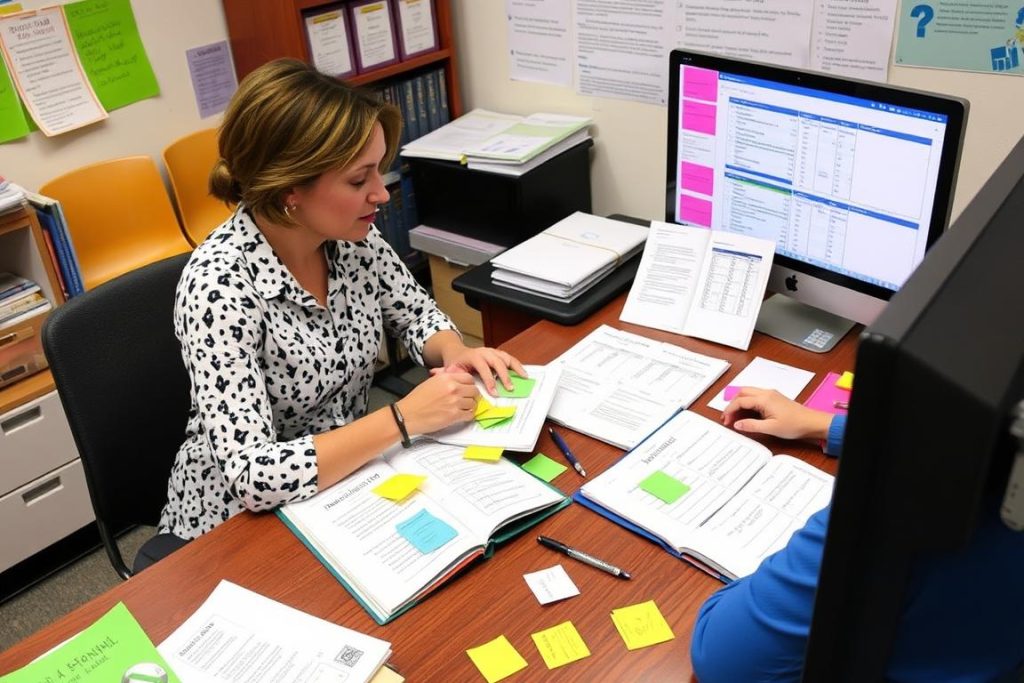
Research cautions that traditional comprehension assessments often focus primarily on literal recall and may not adequately measure deeper comprehension processes. Effective teacher skills include using varied assessment approaches that address multiple levels of comprehension.
Authentic Assessment Approaches
Research supports the use of authentic assessment tasks that more closely mirror real-world reading:
- Performance tasks: Students apply comprehension strategies to solve problems or create products
- Portfolio assessment: Collection of student work showing growth over time
- Discussion-based assessment: Evaluation of student participation in text discussions
- Self-assessment: Students reflect on their own comprehension processes
Teacher skills should include the ability to interpret assessment data and use it to inform instruction. This includes identifying patterns across assessments, determining next steps for whole-class and small-group instruction, and providing targeted feedback to students.
Implementing Effective Reading Comprehension Research and Instruction in Your Classroom
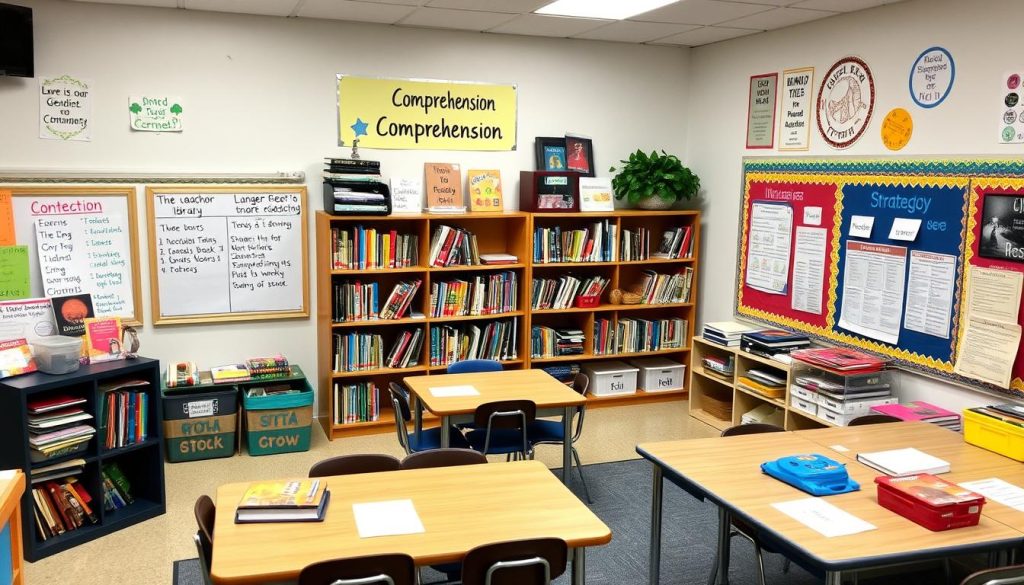
Translating research into practice requires intentional planning and implementation. Developing teacher skills in this area involves creating a comprehensive approach to comprehension instruction that integrates the evidence-based practices discussed throughout this article.
Creating a Comprehensive Approach
Research suggests that effective comprehension instruction includes several key components:
Explicit Strategy Instruction
Teacher skills include:
- Modeling strategies through think-alouds
- Providing guided practice with feedback
- Supporting independent application
- Teaching when and why to use strategies
Knowledge Building
Teacher skills include:
- Selecting content-rich texts
- Building background knowledge
- Making cross-text connections
- Developing academic vocabulary
Text-Based Discussion
Teacher skills include:
- Asking text-dependent questions
- Facilitating student-led discussions
- Teaching discussion protocols
- Supporting evidence-based reasoning
Sample Lesson Structure
Research supports a balanced approach that includes both explicit instruction and authentic application. A comprehensive lesson might include:
- Before Reading: Activate prior knowledge, set purpose, preview text, teach key vocabulary
- During Reading: Model strategy use, guide application, support monitoring
- After Reading: Discuss key ideas, analyze text structure, make connections, apply learning
Effective teacher skills include the ability to integrate these components flexibly based on student needs and instructional goals. The ultimate aim is to develop independent readers who can apply comprehension strategies strategically and flexibly across diverse texts.
Transform Your Reading Comprehension Instruction
Access our complete collection of research-based resources, lesson plans, and professional development opportunities designed specifically for K-12 teachers.
Conclusion: Applying Reading Comprehension Research in Your Classroom
The field of Reading Comprehension Research and Instruction provides valuable insights that can transform your teaching practice. By understanding the complex nature of comprehension and implementing evidence-based strategies, you can help all students develop the skills they need to become proficient, engaged readers.
Key takeaways from the research include:
- Reading comprehension is an active process that involves constructing meaning from text
- Word recognition and language comprehension develop simultaneously, not sequentially
- Background knowledge plays a crucial role in comprehension
- Explicit strategy instruction benefits all readers
- Text structure knowledge supports comprehension
- Different question types engage different levels of thinking
- Effective instruction must be differentiated for diverse learners
Developing teacher skills in these areas requires ongoing professional learning and reflection. As you implement these practices in your classroom, remember that the goal is not just to teach strategies but to develop strategic readers who can flexibly apply their skills across diverse texts and contexts.
By bridging research and practice, you can create a classroom environment where all students have the opportunity to develop deep comprehension skills that will serve them throughout their academic careers and beyond.
Continue Your Professional Learning Journey
Access our comprehensive resources for teaching reading comprehension and earn professional development credits while enhancing your teacher skills.


